



As parents, we often celebrate major milestones like rolling, crawling, walking, and talking. What many people don't realize is that before these milestones can develop, babies rely on a series of automatic movements called primitive reflexes (Healthline).
These reflexes are present from birth and help infants survive, grow, and build important neurological connections. As a child's brain matures, these reflexes should gradually disappear, allowing more purposeful and coordinated movement to take over.
When a reflex remains active beyond the age it typically should, it may be referred to as a retained primitive reflex.
Primitive reflexes are involuntary movement patterns controlled by the brainstem. They are normal and necessary during infancy, helping with feeding, protection, posture, and early motor development.
As higher brain centers mature, these reflexes become "integrated," meaning the child gains voluntary control over movement instead.
Think of primitive reflexes as the training wheels of early development. They're helpful at first, but eventually children need to outgrow them to develop more advanced motor and cognitive skills.
As a child's nervous system matures, primitive reflexes gradually fade away and are replaced by more purposeful, voluntary movement. Most primitive reflexes should no longer be present after the ages listed below.
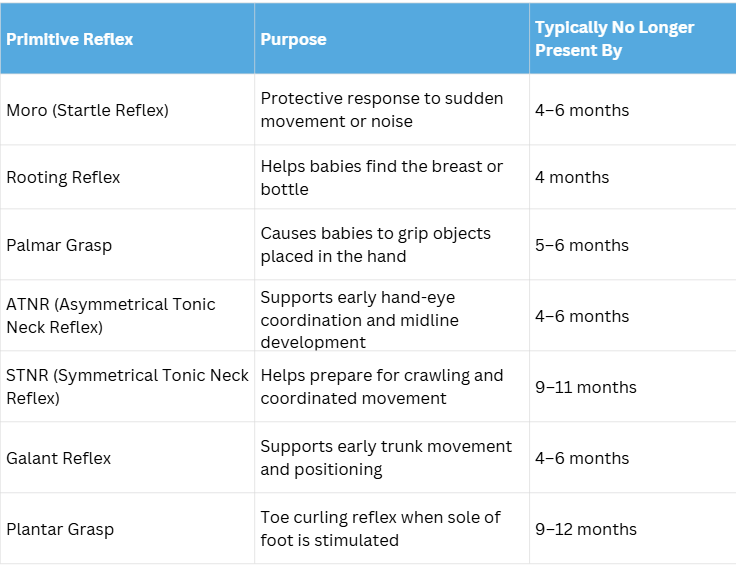
In many children, reflex integration happens naturally with normal development. However, some factors may contribute to reflexes remaining active longer than expected.
Possible contributing factors include:
In many cases, there is no single identifiable cause of retained primitive reflexes. Some children may have contributing factors such as prematurity, limited early movement experiences, or developmental delays, but many children with retained reflexes do not have any clear risk factors at all.
It is also important for parents to know that this is not something they caused. Even in cases where contributing factors are NOT present, development is complex, and these patterns can simply occur as part of how a child’s nervous system matures.
Retained reflexes don't always present in obvious ways. Instead, parents may notice challenges in areas such as movement, coordination, attention, posture, or learning.
Research has found associations between persistent primitive reflexes and challenges with motor skills, posture, coordination, and some aspects of learning and attention, although the strength of these relationships is still being studied.
The topic of retained reflexes has received significant attention in recent years. While studies have found associations between persistent reflexes and developmental challenges, experts continue to debate how much retained reflexes directly cause these difficulties. Current evidence suggests that retained reflexes may be one contributing factor rather than the sole explanation for attention, learning, or behavioral concerns.
For this reason, a comprehensive developmental evaluation is often more helpful than focusing on reflexes alone.
My biggest recommendation if you suspect your child may have retained reflexes is not to panic that something is wrong with your child. Instead, simply get them moving. Movement is one of the primary ways children develop and strengthen the neurological pathways that support coordination, balance, body awareness, and motor control.
Children learn through movement, and some simple exercises can help support body awareness, coordination, balance, and motor control.
Try incorporating activities such as:
One of my general recommendations is simply encouraging activities that naturally incorporate crawling, climbing, balancing, crossing midline, and coordinating both sides of the body together. These movement patterns help build the foundation for more advanced motor skills, attention, and body awareness.
Many of the best "activities" don't feel like activities at all. Time at the playground, riding bikes, swimming, gymnastics, martial arts, dance, hiking, and active outdoor play can all provide valuable movement experiences that support healthy neurological development.
Outdoor environments naturally challenge a child's balance, coordination, strength, and spatial awareness. Running, hiking, exploring uneven terrain, and climbing all provide valuable opportunities for the nervous system to develop and mature.
Many of the activities that support healthy development are surprisingly simple:
These everyday movement experiences can have a powerful impact on a child's overall development.
If you've noticed your child is struggling and movement-based play and at-home activities aren't leading to improvement, or if a teacher, pediatrician, or other third-party recommends exploring additional support, several therapies may be beneficial.
The options I most commonly recommend include occupational therapy, chiropractic care, physical therapy, and, in some cases, a developmental vision evaluation. The best choice depends on your child's specific challenges and developmental needs.
A pediatric occupational therapist can evaluate:
Occupational therapists often incorporate movement-based activities designed to support motor development and reflex integration.
Many of our families choose to work with a pediatric chiropractor who has experience evaluating nervous system function and movement patterns in children. Some children may benefit from an approach that focuses on posture, movement, and overall nervous system support.
For children with gross motor delays, balance concerns, muscle weakness, or coordination challenges, physical therapy can help improve strength, stability, movement patterns, and overall function.
Because some retained reflexes may influence visual tracking and eye coordination, a developmental vision evaluation can be helpful for children experiencing challenges with reading, eye tracking, or visual-motor skills.
Parents should consider discussing concerns with their pediatrician if they notice:
Most importantly, concerns should be evaluated within the context of the child's overall development rather than focusing on any single reflex alone.
If you've noticed challenges with coordination, balance, posture, attention, sensory sensitivities, or other developmental concerns, don't hesitate to bring them up with your pediatrician.
Many retained reflexes can be screened through simple movement-based assessments performed during an office visit. These evaluations help us determine whether retained reflexes may be contributing to your child's challenges and whether additional support could be beneficial.
While primitive reflexes are covered in pediatric training, more advanced assessment of retained reflexes and their potential impact on development often requires additional education and clinical experience. At Restore + Revive, we can help evaluate your child, provide guidance, and connect your family with trusted specialists when appropriate.
Most importantly, if you have concerns about your child's development, trust your instincts. Early evaluation and support can make a meaningful difference.
We would love the opportunity to meet your child, answer your questions, and help determine the best next steps for your family.
Contact our office at 817-720-6220 ext. 2 to schedule an appointment.
.png)